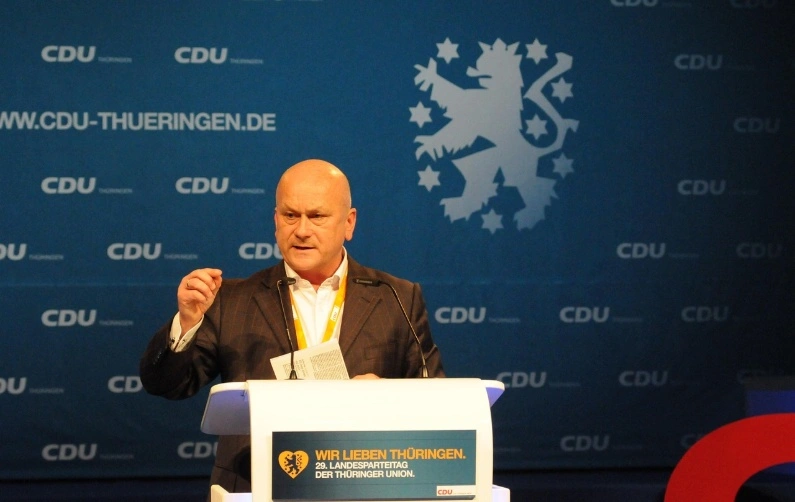
Berlin CDU district branch weighs breaking taboo on backing AfD motions
Section: Politics
The Fontane-Haus in Berlin's Reinickendorf district is marking its 50th anniversary this week, celebrating half a century as the social and cultural centre of the Märkisches Viertel, one of the city's largest postwar housing estates.
The building sits tucked behind the Märkisches Zentrum shopping complex, surrounded by rows of grey twelve-storey apartment blocks that define the estate's skyline. On a grey Thursday afternoon, its gold lettering stood out sharply against the overcast sky and the concrete facades around it, a detail that has become something of a visual signature for the venue over the decades.
According to the institution, the Fontane-Haus opened almost exactly 50 years ago to the day, built to serve a neighbourhood that was, at the time, one of West Berlin's biggest large-scale housing developments. The Märkisches Viertel was constructed in the 1960s and early 1970s to house tens of thousands of residents in a wave of modernist urban planning, and the Fontane-Haus was conceived as a gathering place within that newly built environment.
What began as a neighbourhood house, a modest meeting point for residents of the surrounding tower blocks, has since grown into what is now described as the largest hall in the northern part of Berlin. Over five decades the venue has hosted concerts, community events, markets and civic gatherings, cementing its role as a focal point for a district that was originally designed with few such communal spaces in mind.
The institution's own account of its history notes that the Fontane-Haus very nearly did not survive in its current form. At several points over the past 50 years, its future as a cultural venue was reportedly uncertain, with structural, financial and organisational challenges threatening to change its course entirely. Despite that, the building has remained in continuous use, adapting its programming and management to the needs of a changing neighbourhood.
Residents and visitors to the Märkisches Viertel have long associated the Fontane-Haus with public life in the district, given the limited number of large indoor venues available locally. Its scale, now recognised as the biggest hall of its kind in northern Berlin, has allowed it to accommodate events that smaller neighbourhood venues could not, from large public meetings to bigger cultural productions.
The anniversary comes at a time when the Märkisches Viertel itself continues to be a subject of discussion in Berlin's urban planning circles, given its scale and its status as one of the city's defining examples of postwar mass housing. The estate's twelve-storey blocks, built to address the housing shortages of the mid-20th century, remain a dominant feature of the area's landscape today, and the Fontane-Haus has operated as a counterpoint to that uniform architecture since its earliest days.
District representatives in Reinickendorf have in the past pointed to the Fontane-Haus as an example of how a single building can anchor community life in a large housing estate over multiple generations. Its continued operation across five decades, through changing social and economic conditions in the district, has been cited as evidence of the venue's adaptability.
The building's golden signage, visible from a distance against the grey tower blocks, has become a recognisable marker within the Märkisches Viertel, helping residents orient themselves within an estate often criticised for its uniform appearance. For many who grew up in the surrounding blocks, the Fontane-Haus has functioned as a familiar landmark as much as a functional venue.
No public events marking the exact anniversary date had been detailed beyond the acknowledgement of the milestone itself, though the institution's history, spanning a full half-century in the same location, continues to be referenced locally as part of the broader story of the Märkisches Viertel's development since the 1970s.
Section: Politics
Section: Politics
Section: Business

Section: Science
Section: Business
Section: Science
Section: News
Section: Arts
Section: Business

Section: Business
Both private Health Insurance in Germany and public insurance, is often complicated to navigate, not to mention expensive. As an expat, you are required to navigate this landscape within weeks of arriving, so check our FAQ on PKV. For our guide on resources and access to agents who can give you a competitive quote, try our PKV Calculator.
Germany is famous for its medical expertise and extensive number of hospitals and clinics. See this comprehensive directory of hospitals and clinics across the country, complete with links to their websites, addresses, contact info, and specializations/services.
Didn't manage to get a ticket for Linkin Park? Or still not enough after the concert? Join us at CRASH on June 12th for our "IN THE END" Linkin Park Special + CORE NIGHT.All night long, we'll be playing Linkin Park's music, along with Nu Metal, Metalcore, and Alternative Rock from bands such as Limp...


No comments yet. Be the first to comment!