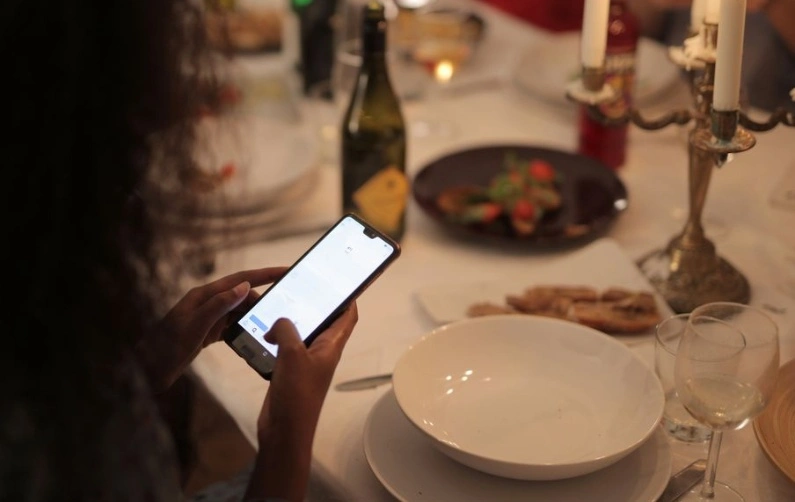
Most Germans call smartphone use at the dinner table rude, survey finds
Section: Arts
Clocks across Germany and most of Europe went back one hour early Sunday, marking the end of daylight saving time and the start of the winter period. At exactly 3 a.m., timepieces were set back to 2 a.m., restoring what is officially known as Central European Time, commonly referred to as winter time.
The switch gave most people an extra hour of sleep overnight but means darkness will now fall noticeably earlier in the evenings in the weeks ahead. The change applies not only in Germany but in the majority of European countries, which coordinate the biannual adjustment.
Responsibility for the automatic time change in Germany rests with the Physikalisch-Technische Bundesanstalt, the national metrology institute based in Braunschweig. Technicians at the agency oversee a long-wave radio transmitter called DCF77, located in Mainflingen near Frankfurt am Main, which broadcasts the precise time signal used to synchronize radio-controlled clocks, station clocks and many industrial timekeeping systems throughout the country.
The transmitter's signal allows millions of devices, from household alarm clocks to clocks in railway stations and factories, to update automatically without manual intervention. The institute's experts manage the technical side of the switch each year, ensuring the signal reflects the correct time the moment the change takes effect.
Germany reintroduced seasonal clock changes in 1980, after they had been abandoned decades earlier, with the stated goal of conserving energy. The idea was that shifting clocks forward in spring and back in autumn would allow better use of natural daylight, reducing the need for artificial lighting during waking hours.
Since then, the pattern has repeated every year without exception. Clocks are moved forward by one hour at the end of March, ushering in daylight saving time, often called summer time, and then set back by one hour at the end of October, returning the country to standard time.
The practice has long been a subject of debate in Europe, with critics questioning whether the energy savings the policy was designed to achieve are still significant given changes in technology and lighting efficiency over the past four decades. Studies on the actual energy impact of the time change have produced mixed results over the years, and the European Union has previously discussed proposals to end the twice-yearly shift altogether.
Despite periodic political discussion about abolishing the seasonal changes, no binding agreement has been reached among European Union member states on a permanent alternative, and the practice has continued largely unchanged. For now, the twice-yearly ritual remains in place across the continent, affecting travel schedules, broadcasting times and daily routines for hundreds of millions of people.
In Germany, the shift to winter time typically brings earlier sunsets, with darkness arriving well before the evening commute for many workers in the weeks following the change. Public health officials and sleep researchers have periodically noted that the transition, while modest, can briefly disrupt sleep patterns for some individuals before the body adjusts to the new schedule.
Transport operators, including railway and airline companies, factor the time change into their schedules in advance, and most digital devices, including smartphones and computers, update automatically. Older devices relying on the DCF77 signal or manual settings require the physical adjustment carried out by users or technicians overnight.
The next scheduled time change will come at the end of March, when clocks move forward again by one hour to mark the return of daylight saving time. Until then, Central European Time, or winter time, will remain in effect across Germany and most of the European Union.
Section: Arts
Section: Science

Section: News
Section: Business
Section: Politics
Section: Politics
Section: Business
Section: Business
Section: Science
Section: Business
Both private Health Insurance in Germany and public insurance, is often complicated to navigate, not to mention expensive. As an expat, you are required to navigate this landscape within weeks of arriving, so check our FAQ on PKV. For our guide on resources and access to agents who can give you a competitive quote, try our PKV Calculator.
Germany is famous for its medical expertise and extensive number of hospitals and clinics. See this comprehensive directory of hospitals and clinics across the country, complete with links to their websites, addresses, contact info, and specializations/services.
Didn't manage to get a ticket for Linkin Park? Or still not enough after the concert? Join us at CRASH on June 12th for our "IN THE END" Linkin Park Special + CORE NIGHT.All night long, we'll be playing Linkin Park's music, along with Nu Metal, Metalcore, and Alternative Rock from bands such as Limp...

No comments yet. Be the first to comment!